Bryn Mawr Historic District [Edgewater Presbyterian Church]

  • Subscribe to our RSS feed.
  • Twitter
  • StumbleUpon
  • Reddit
  • Facebook
  • Digg

Thursday, November 18, 2010

IIT Campus: The McCormick Tribune Campus Center..

Posted on 3:46 AM by babli panday


The Exelon Tube.. A concrete tube, clad in corrugated stainless steel, that wraps the CTA elevated railroad ["L"] tracks to dampen the train noise.. The concrete and stainless steel tube encloses a 530-foot stretch of the L tracks... and it really dampens the sound of the trains over-head as students enjoy various campus activities below.
And beneath this Exelon Tube is the Campus Center.


Students playing in the Campus Center, as a Green Line train passes right above them, through the Exelon Tube..

The Exelon Tube and The McCormick Tribune Campus Center..
Location: 33rd and State Streets, on Chicago's south side.
Designed by Pritzker Prize winning architect Rem Koolhaas, of the Office for Metropolitan Architecture [OMA], Rotterdam..
This is Koolhaas' first completed building in the United States..

Under the Exelon Tube, is the main building, a one-story, 110,000 square foot structure containing the program spaces (Welcome Center, dining, auditorium, meeting rooms, bookstore, cafe, post office, offices, convenience store, and campus radio station) under the tube. Movement through the main building is along diagonal paths located according to research analyzing the walking patterns of students across the site. Seeking to accommodate students, the paths intersect to create island spaces and nodes of activity for the students and faculty
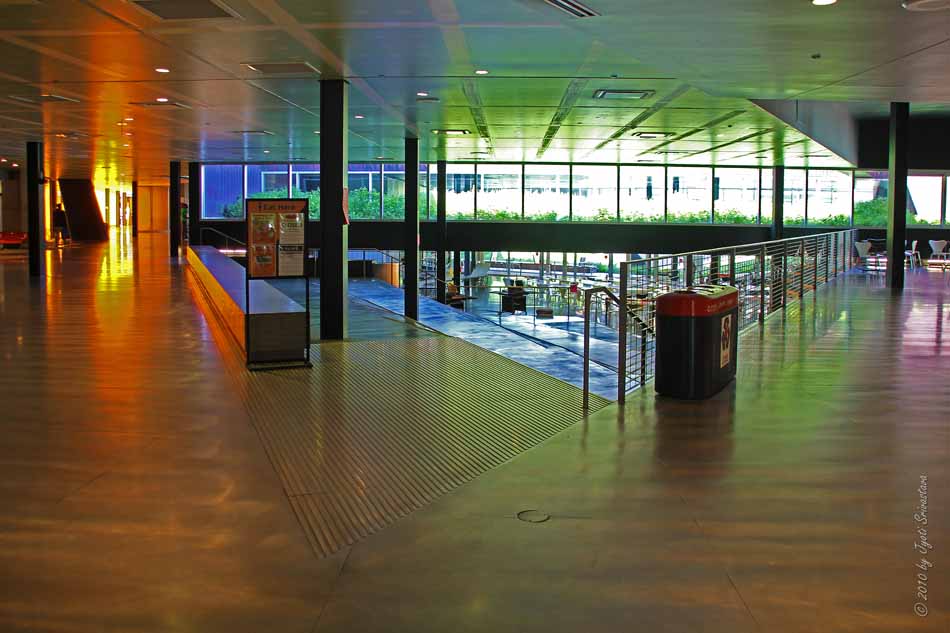

As one enters the building, this is the view. Orange hues on the west side and green in the center..


The Ramp-Seating..
As we enter, we see these steps and space.. This terrain is for student gathering. Notice the steps skillfull of steps and handicapped ramp at the same time. Apart for providing space for gathering, it leads to the center-court.


Center Court..
The ramp leads to a sunken two-story center court, with recreational and dining area.. This might have been a dingy basement..


Hanging Garden..
Note the hanging garden lies above the center-court. It brings light and nature to the heart of the building.


Broadband..
A sunken area, with a continuous band of computer stations.. The 93-foot-long shelf is painted a bright red.


Mies Wrap/ Orange Hallway..
A continuous orange wall on the west side of the building, that brightens the entire interior..And I love the color orange..


Lobby..


Recreational Area..
Just beneath the railway tracks, covered in the Exelon Tube..
The main federating element is the roof, a continuous concrete slab that shields the centre from the noise of the elevated railway while unifying the heterogeneity below.
- Rem Koolhas..


Welcome Center..


Glass portrait of Mies van der Rohe..
On the northwest side of the building, visitors enter through a 20-foot image of Mies’s face.. The master plan of the IIT campus, wasdesigned by Mies in 1941. It is one of the largest projects he conceived. The campus encompasses 20 of his buildings, the greatest concentration of Mies-designed buildings in the world.


The Map..
Read More
Posted in | No comments

Saturday, October 23, 2010

Tiffany in Chicago..

Posted on 4:50 AM by babli panday


Tiffany dome at Marshall Field's [now Macy's] at State Street..

Tiffany in Chicago..
Louis Comfort Tiffany and John LaFarge [two known rivals] created milestones in the development of new techniques for making stained glass windows in the late 19th and early 20th century. In this post I am concentrating on the works of Louis Comfort Tiffany and his Tiffany Studio. In 1885, Louis Comfort Tiffany founded the Tiffany Glass Company, which in 1890 became the Tiffany Studio.

The name of Tiffany is closely associated with..
- The creation of "favrile" glass, patented by Louis C. Tiffany in 1894..
- Developments in stained glass techniques, especially drapery glass..
- Not only is the Tiffany Studio, credited with innovative techniques, but also brought changes in the theme of stained glass windows, from religious compositions, to pastoral scenes, ornamental designs and also floral motifs.


Tiffany Dome at Marshall Fields [now Macy's] at State Street..
Installed: 1907
Designed by Louis C. Tiffany
It is both the first dome to be built in favrile iridescent glass and is the largest glass mosaic of it's kind. It contains over 1.6 million pieces. The late Louis C. Tiffany designed this glass mosaic dome. "Favrile" glass are handmade and the "iridescent effect" was obtained by mixing different colors of glass while hot. "Favrile iridescent glass" is a type of art glass patented in 1894 by Louis Comfort Tiffany...


Preston Bradley Hall..
Chicago Cultural Center..
The centerpiece is a 38-foot Tiffany glass dome designed by artist J. A. Holtzer. The Cultural Center states this to be the largest Tiffany dome in the world, with an estimated value of $35 million..


The lobby of Marquette Building..
The mosaics are the work of Louis Comfort Tiffany and J.A.Holzer.. Holzer was chief designer for the Tiffany Glass and Decorating company. These mosaics are composed entirely of mother of pearl and Favrile glass..


The lobby of Marquette Building..
Words inscribed.. They answered they were Illinois and in token of peace presented the pipes to smoke..


Field of Lilies..
Designed, Fabricated by Tiffany Studio..
Location: Tiffany Gallery, within the Smith Museum of Stained Glass Windows at Navy Pier..
 
Louis Comfort Tiffany was not satisfied with brushwork on glass.. "Glass covered in brushwork produced an effect both dull and artificial".. He said.. "I could not make an inspiring window with paint. I had to use a medium which appealed to me.. How many times I have tried to make drapery glass? My chemist and my furnanceman for a long time insisted it was impossible, claiming that the metallic oxides would not combine, and that was the trouble for many years. The mix would disintegrate. New styles of firing ovens had to be built, new methods.. for annealing glass.."


Autumn Landscape [1890s]..
This window is from Tiffany's Impressionist period. Selected sheets of Favril glass are combined into a sky as "impressionist" as one produced by the painters. The window appears even more spontaneous because of the light that is transmitted through it, a uniqueness of glass unknown to the painters on canvas.


Two Angels [1910]..
Designed and Fabricated by Tiffany Studio..
Location: Tiffany Gallery, within the Smith Museum of Stained Glass Windows at Navy Pier..

The marker reads..
All the various glass inventions of Louis Comfort Tiffany can be studied in this superb pair of angels. Angels seated in the fields of lilies indicate divine purity. This symbolism is carried to a thoughtful conclusion by the angels beautifully feathered white wings and drapery-folded garments. The use of pastel colors contribute to the serenity. As with all Tiffany figurative windows, the exposed faces, hands and feet are painted..


Hanging Head Dragonfly Shade on Mosaic and Turtleback Base..
at the Art Institute of Chicago..
Design attributed to Carla Pierce Wolcott Driscoll of the Tiffany company..
Description: 1906 / Favrile glass and bronze..

The marker reads..
Around 1898 Louis Comfort Tiffany's firm began creating lamps fitted for electricity with trademark Favrile glass, which feature subtle shading and unique textural effects. As artistic director, Tiffany approved all patterns but designed relatively few lamps himself. Clara Driscoll, head of Women's Glass Cutting Department at Tiffany Studios, was likely responsible for design of this shade and base. She began working for Tiffany in 1888, and designed the majority of the firms lamps until she left the company in 1908 or 1909.


Stained glass dome at Fullerton Hall..
Designed by Louis Comfort Tiffany..
Completed: 1901.
at the Art Institute of Chicago..
In 1901, the Fullerton Hall's pendant space, the Ryerson Library was completed as well..


The Second Presbyterian Church has an amazing collection of stained glass windows by Tiffany. But I need to go there again for closer images of the windows..
Read More
Posted in | No comments

Tuesday, October 19, 2010

Merchandise Mart : Enviornment Friendly

Posted on 9:29 AM by babli panday


I'm Very curious about how does this work???

Read the text below,
It's on the stickers pasted on the Merchandise Mart revolving doors..

Welcome to world's largest LEED-EB Silver Certified Building where every revolution reduces pollution..
FACT: If our 25,000 daily visitors used the revolving doors the pollution equivalent of 50 car trips from New York City to Los Angeles could be eliminated every year..


Read More
Posted in | No comments

Friday, October 1, 2010

Graceland Cemetery

Posted on 8:05 AM by babli panday

Tomb of Dr. Christopher D. Manuel....

Graceland Cemetery..
The final resting place of many who have written the story of Chicago.. Established in 1860, it covers 119 acres. It was designed by landscape architects O.C.Simmonds and H.W.S Cleveland,in Victorian-style with landscaped parks and memorial markers. Many of the cemetery's tombs are of great architectural or artistic interest. Particularly prominent is the Getty Tomb, which is now designated a Chicago Landmark. It was designed by Louis Sullivan, who also designed Martin Ryerson mausoleum and the Schoenhofen Pyramid Mausoleum. Sullivan himself is also buried here.

Walking through the cemetery one can pay respect to the pioneers, early settler, business leaders, civic planners, architects, politicians and other Chicago luminaries. Pioneers like Dexter Graves and John Kinzie .. business leaders like Potter Palmer, George Pullman, Cyrus Hall McCormick, Marshall Fields .. civic planners like Daniel Burnham ... world famous Chicago architects like John Root, William Holabird, Louis Sullivan, Howard Van Doren Shaw, William LeBaron Jenny, Ludwig Mies van der Rohe .. As many leading Chicago architects have their final resting place here, it is also called the "Cemetery of Architects"..


Dexter Graves [1789-1844]..
Hotel owner, early settler..
Lorado Taft created sculpture "Eternal Silence", in 1909..
For more.. click here..


Victor F. Lawson [1850-1925]..
Newspaper publisher, owner of Chicago Daily News..
Lorado Taft created sculpture "Crusader", in 1931..
For more.. click here..


Henry H. Getty [ 1837-1920]..
Lumber merchant..
Tomb was designed by Louis Sullivan in 1890, and is now a Chicago Landmark..
For more.. click here


Martin A Ryerson [1818-1887]..
Lumber merchant and developer..
Tomb was designed by Louis Sullivan, in 1889..
For more.. click here..


Potter Palmer [1862-1902]..
Chicago developer and merchant..
Tomb was designed by McKim Mead and White in 1902..
For more .. click here..


Henry H. Honore [1823-1916]..
Developer..
Tomb was designed by McKim, Mead and White in 1906..
For more.. click here..


William W. Kimball [1828-1904]
Piano manufacturer..
Tomb was designed by McKim Mead & White in 1905..
It was Stanford White's final design..Ref: Designslingers.. click here..
For more.. click here..


Marshall Field [1835-1906]
Founder of retailing empire Marshall Field's & Co.
Tomb was designed by Henry Bacon and Daniel Chester French in 1906..
For more.. click here..

Graceland Cemetery is also called the "Cemetery of Architects"... as it is the final resting place of many leading Chicago architects ..
- Louis Sullivan [1856 -1924]
- John Root [1850 –1891]
- Daniel Burnham [1846 - 1912]
- Howard Van Doren Shaw [1868 - 1926]
- Ludwig Mies van der Rohe [1886 -1969]
- Fazlur Khan [1929 – 1982]
- William Le Baron Jenney [1832 - 1907]
- Dwight Heald Perkins [1867 -1941]
- Bruce Goff [1904 -1982]


Louis H. Sullivan [1856-1924]..
Architect..
Tomb designed by Tallmadge, Watson, 1924..
For more.. click here..


Daniel Burnham [1846-1912]..
Architect, city-palnner, Columbian Exposition [1893], Plan of Chicago [1909]..
For more.. click here..


John W. Root [1850-1891]
Architect, famous partnership with Daniel Burnham in architectural firm Burnham & Root..
Tomb designed by Burnham & Root, Atwood, Wegman..
For more.. click here..


Howard Van Doren Shaw [1868-1926]..
Architect of many Chicago buildings..
For more.. click here..


Ludwig Mies van der Rohe [1886-1906]..
Architect
For more.. click here..

Cummings..

Dr. Christopher D. Manuel..

References:
# Official Website for Graceland Cemetery..
# Graceland Cemetery..
# The cemetery of architects
Read More
Posted in | No comments
Newer Posts Older Posts Home
Subscribe to: Posts (Atom)

Popular Posts

  • Index
    THE LOOP # 1 South Wacker Drive [Architect: Helmut Jahn /1982] # 333 Wacker Drive [Architects: Kohn Pedersen Fox Associates PC/1983] # A...
  • Louis Sullivan's Ann Halsted Row Houses..
    Ann Halsted Row Houses.. [1884-85] 1826-34 N. Lincoln Park West.. Architects: Adler & Sullivan A set of five row houses. Dankmar Adler ...
  • Milwaukee Art Museum: The Quadracci Pavilion
    Milwaukee Art Museum.. The Quadracci Pavilion.. is an architectural addition to the Milwaukee Art Museum. The name, "Quadracci Pavilio...
  • S. Dearborn Street [Fisher Building]
    Fisher Building.. Address: 343 S. Dearborn St. Year Built: 1896 North addition, 1907 Architect: Burnham & Co. North addition: Peter Webe...
  • Lurie Garden: "The New Wave Planting Style"
    Continued from the post on Lurie Garden.. click here.. Lurie Garden is one of the first examples in the United States to experiment with the...
  • S Dearborn Street [Fisher Building - II , Sculptural Ornamentation]
    Fisher Building.. Address: 343 S. Dearborn St. Year Built: 1896 North addition: 1907 Architect: Burnham & Co. North addition: Peter Webe...
  • The Second Presbyterian Church
    The Second Presbyterian Church.. Address: 1936 S. Michigan Ave. Year Built: 1874 ..reconstructed in 1900.. Architect: Original construction,...
  • S. Dearborn Street [Old Colony Building]
    Old Colony Building.. Address: 407 S. Dearborn St. Year Built: 1894 Architect: Holabird & Roche Date Designated a Chicago Landmark: July...
  • S. Dearborn Street [Manhattan Building - I ]
    Manhattan Building.. Address: 431 S. Dearborn St. Year Built: 1891 Architect: William Le Baron Jenney Date Designated a Chicago Landmark: Ju...
  • Roloson Houses
    Front Elevation of the houses for R.W.Roloson Houses, in the exhibition, Wright's Roots.. Wright's Roots Location:  Expo 72 72 E. Ra...

Blog Archive

  • ▼  2012 (31)
    • ▼  October (1)
      • Windfarms of Indiana
    • ►  August (2)
    • ►  July (1)
    • ►  June (4)
    • ►  May (5)
    • ►  April (1)
    • ►  February (14)
    • ►  January (3)
  • ►  2011 (93)
    • ►  December (1)
    • ►  November (7)
    • ►  October (3)
    • ►  September (10)
    • ►  August (6)
    • ►  July (7)
    • ►  June (3)
    • ►  May (16)
    • ►  April (4)
    • ►  March (21)
    • ►  February (12)
    • ►  January (3)
  • ►  2010 (165)
    • ►  December (2)
    • ►  November (1)
    • ►  October (14)
    • ►  September (14)
    • ►  August (9)
    • ►  July (22)
    • ►  June (21)
    • ►  May (7)
    • ►  April (8)
    • ►  March (30)
    • ►  February (24)
    • ►  January (13)
  • ►  2009 (126)
    • ►  November (3)
    • ►  October (3)
    • ►  September (35)
    • ►  August (1)
    • ►  July (10)
    • ►  April (17)
    • ►  March (7)
    • ►  February (23)
    • ►  January (27)
  • ►  2008 (1)
    • ►  December (1)
  • ►  2007 (14)
    • ►  December (7)
    • ►  September (6)
    • ►  June (1)
  • ►  2006 (14)
    • ►  February (5)
    • ►  January (9)
Powered by Blogger.

About Me

babli panday
View my complete profile