Today was one of my worst days in the [still] New Year.. It was one of the days for which exemplifies Murphy's Law... Anything that can go wrong, will go wrong.. And 'almost' everything went wrong.. Except for these spring images, At the end of the day, I think, the day was not all that bad.. How a few satisfactory images can save a day!
Pilgrim Baptist Church.. Address: 3301 S. Indiana Ave. Year Built: 1890-91 Architect: Dankmar Adler & Louis Sullivan Date Designated a Chicago Landmark: December 18, 1981..
The building was built as a synagogue [Kehilath Anshe Ma'ariv synagogue].. Dankmar Adler was a member, and his father was a rabbi. [That congregation now continues as K.A.M. Isaiah Israel Temple]... A Baptist congregation moved into the building in 1922, forming the Pilgrim Baptist Church.
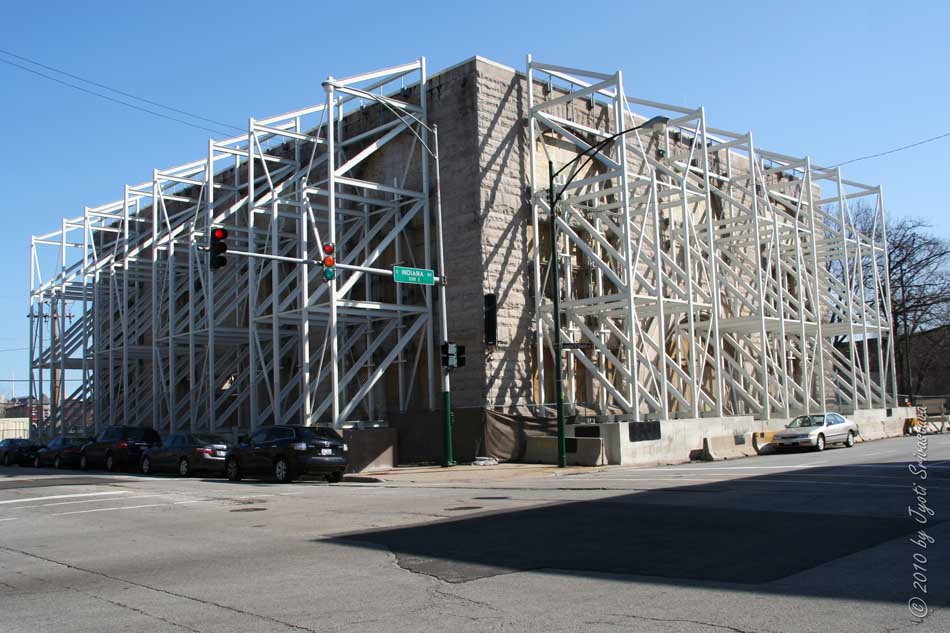
Chicago Landmark burned.. On January 6, 2006, the church suffered from a massive fire, which damaged it's architecturally significant interior. Now only the shell remains. And there is little hope of any recovery.
Birthplace of Gospel.. Thomas A Dorsey, known as the Father of Gospel music, was the the choir director at Pilgrim Baptist Church from 1932 to 1970. His most famous song, "Precious Lord, Take My Hand" was introduced here. The song was a favourite of Father Rev. Martin Luther King Jr. Precious Lord, take my hand Lead me on, help me stand I am tired, I am weak, I am worn Through the storm, Through the night Lead me on to the light Take my hand, precious lord Lead me home.. Many famous singers are among those who have sung at the church, including Mahalia Jackson, Aretha Franklin, Sallie Martin, James Cleveland, and Edwin Hawkins .. Its famous members include Bessie Coleman, the first African American female pilot and the first person of African American descent to hold an international pilot license. Dr Martin Luther King Jr. also delivered some sermons in the church during the height of the Civil Rights Movement.
Architectural History.. Although best known for its association with gospel music of the early 20th century, the Pilgrim Baptist Church has an important place in architectural history of the city. It was designed by Dankmar Adler and Louis Sullivan during a period in which Frank Lloyd Wright worked for their firm.
Now, destroyed by the fire, only the shell of the building remains. One can still see the three-story stone facade, although it's tall attic and the steeply hipped roof are destroyed. Behind the steel support, one can see a stepped voussoir arch entrance and arched third story windows. Inside the sanctuary was a soaring wooden ceiling in golden tone. There was a continuous row of Sullivan-designed terra cotta at the base. In the terra cotta and in the stained-glass windows were Jewish iconography which Pilgrim Baptist Church retained, but a large cross was added above the altar.
The architect Dankmar Adler was a self-taught acoustical engineer. This engineering masterpiece from Adler and an equally impressive architectural decoration by his younger partner Sullivan has now been lost forever.
Grant controversy.. The now disgraced and ousted Governor Rod Blagojevich had pledged $1 million to help rebuild the non-church part of the building, administrative offices that housed the church’s school and historic documents. But there were legal complaints filed questioning the constitutionality of the grant. The issue cited was that the state’s constitution does not permit public funding church-run schools. It was alleged that it was impossible to limit the funding to the church’s “secular” functions and the grant was unconstitutional. I dont know what happened with the case, but the grant has been cancelled, citing insufficient funds with the Illinois State.
Pilgrim Baptist Church, is yet another of the Adler & Sullivan’s buildings have been destroyed/ demolished, like the Schiller Theater, the Stock Exchange and earlier buildings such as the Troescher and Ryerson.
Nine Bronzeville Structures and Beyond.. There are many stuctures beyond the nine structures that the Chicago Landmark Commission describes as.. "These nine structures are what remain of the "Metropolis," one of the nation's most significant landmarks of African-American urban history"... It does not include the Pilgrim Baptist Church.. Although now it's destroyed by the fire, it was not so at the time when the Black Metropolis District was designated on Sep 9, 1998.. For more on the Nine Structures and Beyond.. click here..
Calumet-Giles-Prairie District.. Address: 3100-3500 blocks of Calumet, Giles and Prairie Avenues Year Built: 1870-1910 Architect: Various.. Date Designated a Chicago Landmark: July 13, 1988..
The three city blocks between 31st and 35th Streets - known as the "Gap" - is one of the few surviving collections of rowhouses on the South Side, dating from the late-19th and early-20th centuries. It's referred to as the "Gap," due to its survival in the midst of other areas that had been cleared for redevelopment in the 1960s. It includes the Roloson Houses..
In recent years, the area has undergone substantial rehabilitation, including construction of many new "infill" residences.
In 1941, the Chicago Housing Authority constructed the Ida B. Wells public housing project south of 35th Street. It which was the first CHA project built specifically for black residents. Those days public housing was officially segregated by racial covenants. Several square miles of late 19th and early 20th century small scale, residential housing were demolished to make way for huge, low-income, high-rise developments all around Calumet, Giles and Prairie Avenues. The three blocks of Calumet-Giles-Prairie District also had it's share of demolition.. although many buildings still survive and showcase the rowhouses during the late-19th and early-20th centuries..
The Chicago Housing Authority [CHA].. was founded in 1937.. It is responsible for all public housing in the city of Chicago. It is a municipal not-for-profit corporation, governed by commissioners who are appointed by the mayor.
Prior to World War II there were four projects, all composed of low-rise [two-to-four-story] buildings... - Jane Addams Houses on the Near West Side - Julia C. Lathrop Homes on the North Side - Trumbull Park Homes on the far South Side.. - Ida B. Wells Homes, in the South Side.. The Ida B.Wells Project was different from other projects, as it was for the Blacks. It was also far larger than the other projects.
The racial segregation embodied in these developments was in compliance with federal policy [the “Neighborhood Composition Rule”], which required that the tenants of a housing development be of the same race as the people of the area in which it was located. Managers were selective in choosing among the thousands of families who applied for apartments. There had to be one employed breadwinner and the tenants had to behave according to prescribed rules.. [REf:Chicago Housing Authority.. Encyclopedia of Chicago..]
I have yet to see the Ida B. Wells Apartment.. and will post it's photos, when I see them..
However, it seems that just across the S Dr. Martin Luther King Jr. street, from the Calumet-Giles-Prairie Avenue, was the slums area.. and the Lake Meadows Apartments were built on slum clearance, between 31st and 35th Streets..
The Illinois Institute of Technology and Michael Reese Hospital organized the South Side Planning Board, which planned the community and secured funding from New York Life Insurance Company. The ground breaking was held in 1952, and the units were built between 1953 and 1968. Initially, Lake Meadows stood as an example of an interracial, middle-class community, although now it has became a largely black community.
Cermak Road Bridge District.. Address: Cermak Road, predominantly between Grove and Jefferson Sts. Year Built: 1901-1924 Architect: Various Date Designated a Chicago Landmark: April 26, 2006..
The Cermak Road Bridge, built in 1906, is the City's last-remaining double leaf Scherzer Rolling Lift Bridge... AND.. The four large industrial buildings, built between 1901 and 1924, framing the Cermak Road Bridge makes for the finest intact, early 20th-century riverfront industrial precinct in Chicago. These four buildings are: - Hoyt Building [Nimmons & Fellows, 1909] - Thomson and Taylor Spice Building [Chatten & Hammond, 1911] - Western Shade Cloth Building [Lockwood Green & Co., 1924] - Wendnagel & Co. Warehouse [1901]
These buildings are stunning examples of industrial architecture during the 20th century and illustrates Chicago's importance as the transportation center of the country at that time.." - Mayor Richard M. Daley.
The oldest building in the district, the Wendnagel & Co. Warehouse, 2120-36 S. Jefferson St. It is built in starkly utilitarian style with little ornamentation. The three later buildings, the Thomson & Taylor Spice Co, Western Shade Cloth Co., and W. H. Hoyt Building, show greater effort towards decorative embellishments.
The Chicago Landmarks website.. The District commemorates the importance of the Chicago River in the economic development of the City and conveys how the interconnected river and rail network made Chicago a national center of commerce. Individually, the buildings are fine examples of early 20th-century industrial architecture, and collectively they represent an almost vanished aspect of Chicago's historical industrial streetscapes...
Cermak Road Bridge - Scherzer Rolling Lift bridge.. In the City of Chicago, where majority of bridges built are trunnion bascule bridges, Scherzer Rolling Lift bridge becomes even more interesting. Designed in 1906 by WIlliam Scherzer, this double leaf rolling lift bascule bridge is the last of its kind in Chicago. In a trunnion bascule bridge, the bridge pivots around a trunnion, with the counterweight concealed below the street. But in a Scherzer rolling lift bridge the counterweight is suspended above the truss, and the bridge rocks backward away from the river.
Location of the above mentioned four buildings.. - W. M. Hoyt Co. bldg. - 465 W. Cermak, Chicago, IL 60616 - Thomson & Taylor Spice Co - 500 W. Cermak - Western Shade Cloth Co - 2141 S. Jefferson St - Wendnagel & Co. Warehouse - 2120-36 S. Jefferson St
Sydney Kent House.. Address: 2944 S. Michigan Ave. Year Built: 1883 Architect: Burnham & Root Date Designated a Chicago Landmark: March 18, 1987..
It's always a pleasure to see a beautiful building like this in an unexpected place.. And a bonus is to learn that it's by the firm Holabird and Root and that it's design is said to be a precursor to wide window openings in the firm's later works as Rookery and Monadonock!
The plaque reads.. Chicago Landmark.. Sidney A Kent House Burnham & Root, architect 1883 The generous window openings and the sculpted qualities of the materials are a precursor to the firm's later works such as Rookery and Monadonock buildings. Built for one of the founders of the Chicago Union Stock Yard Company, this is one of the few remaining mansions on this section of South Michigan Avenue. The second owner was John "Bet A Million" Gates, who was as well known for his gambling exploits as for his business skills in the barbed wire industry. Designated on March 18, 1987 Harold Washington, Mayor Commission on Chicago Landmarks..
Wood-Maxey-Boyd House.. Address: 2801 S. Prairie Avenue Year Built: 1885 Architect: John C. Cochrane Date Designated a Chicago Landmark: October 1, 2003..
This Queen Anne-style mansion built for lumberman George E. Wood in 1885.. The house was once part of "Lower Prairie Avenue," a section of the City's most prestigious 19th-century residential street between 26th and 30th Streets that was almost completely redeveloped under urban renewal efforts in the 1950s and 60s.. The house's current owner, Dr. Alva Maxey-Boyd, bought the house with her husband, Charles Boyd, in 1948, and it was through their decades-long efforts that the house survives today.